
HR-GLX01
Dispensing on electronic assemblies.
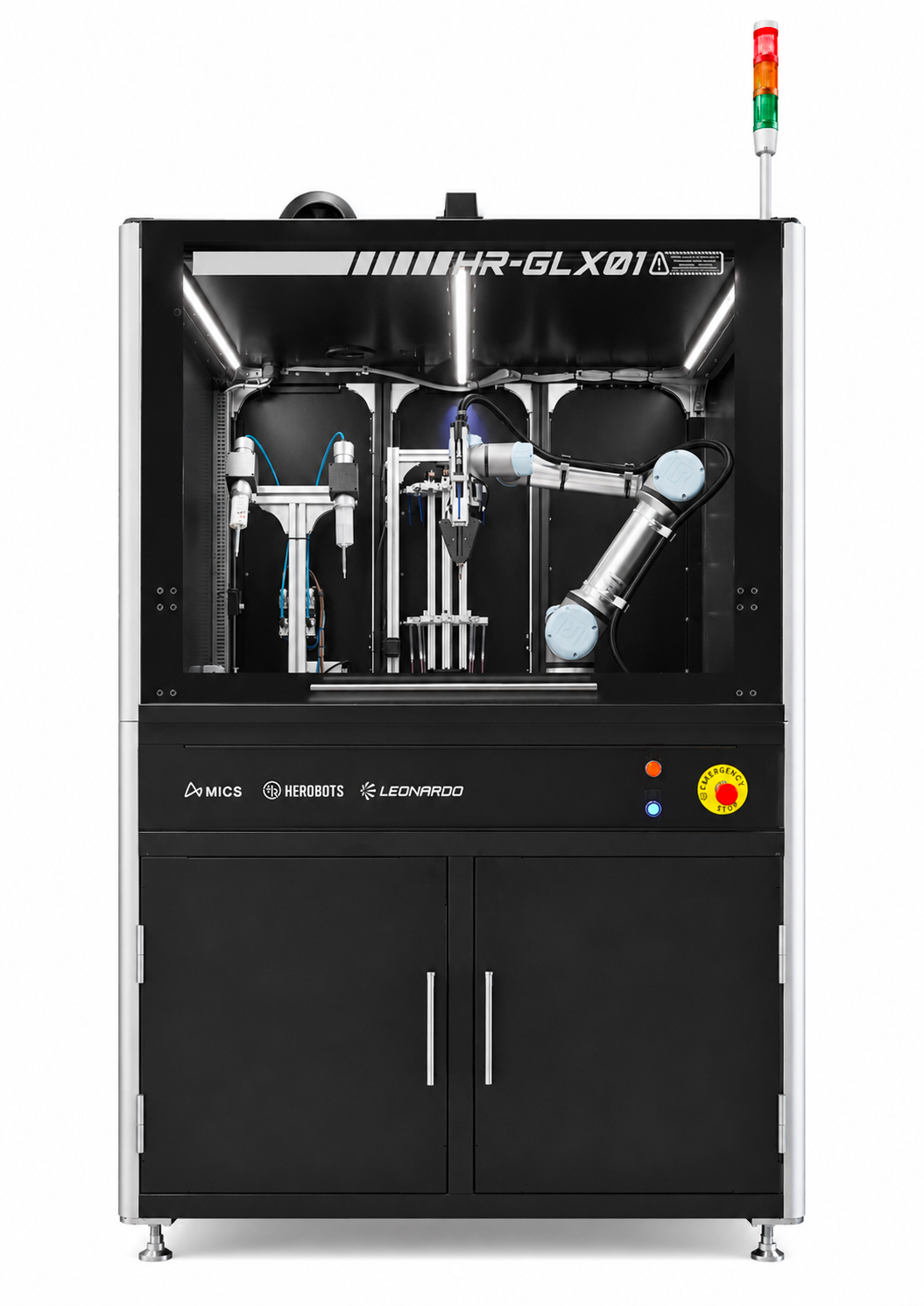
HR-GLX01 cell is a specialized platform for dispensing operations on electronic assemblies, capable of operating both before and after soldering processes. The system supports the application of both single-component and two-component adhesives, ensuring high precision, reliability, and repeatability throughout the production process.
Precise
Accurate dispensing even in complex areas
Safe
Protects components and operators
Traceable
Reduces errors, waste, cycle times
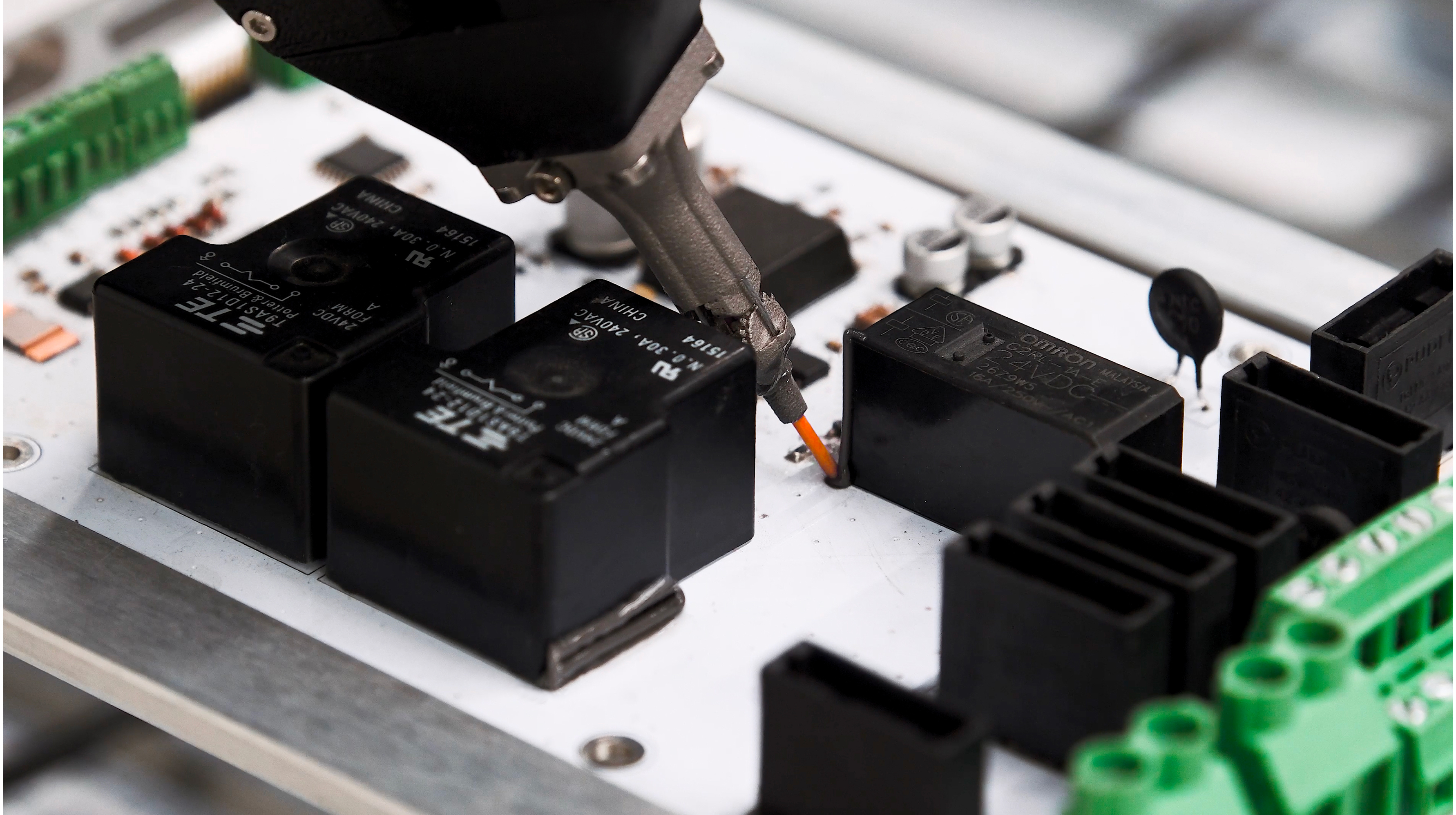
bonding
Bonding execution
Through the proprietary software, operators can program and simulate different bonding strategies on components, identifying the optimal adhesive dispensing point and verifying potential collisions. The user has full control on a vast range of geometric parameters, allowing different bonding styles.
challenge
The challenge of adhesive applications on electronic boards
Applying adhesives on electronic boards can be challenging due to the limited accessibility of areas located between densely packed components. The GLX01 cell is designed to accurately reach these difficult locations, support the use of two-component adhesives through an automatic micro-cartridge replacement system and a precision-controlled actuator that ensures accurate adhesive flow regulation.
Confined access
Adhesive has to reach areas between densely packed components, where a rigid nozzle cannot enter.
Controlled flow
A precision-controlled actuator regulates adhesive flow, keeping the dispensed quantity repeatable.
Two-component adhesives
An automatic micro-cartridge replacement system handles two-component adhesives without operator intervention.
T-Bot technology
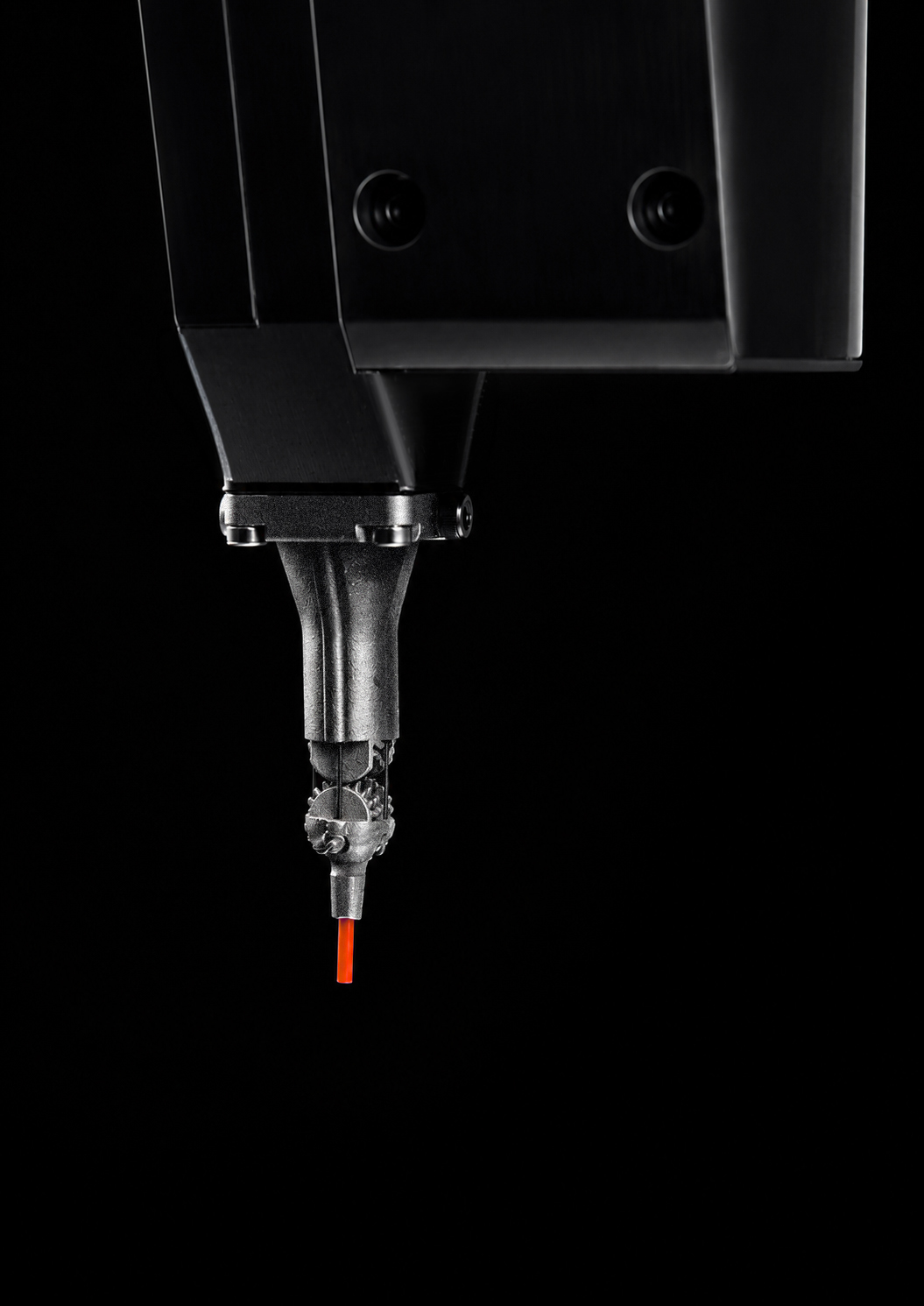
A needle that bends.
A wrist that steers it.
The needle is actuated by a tendon system that controls its flexion, so the tool operates like an industrial surgeon, reaching dispensing points inside geometries a rigid nozzle cannot enter.
dispenser
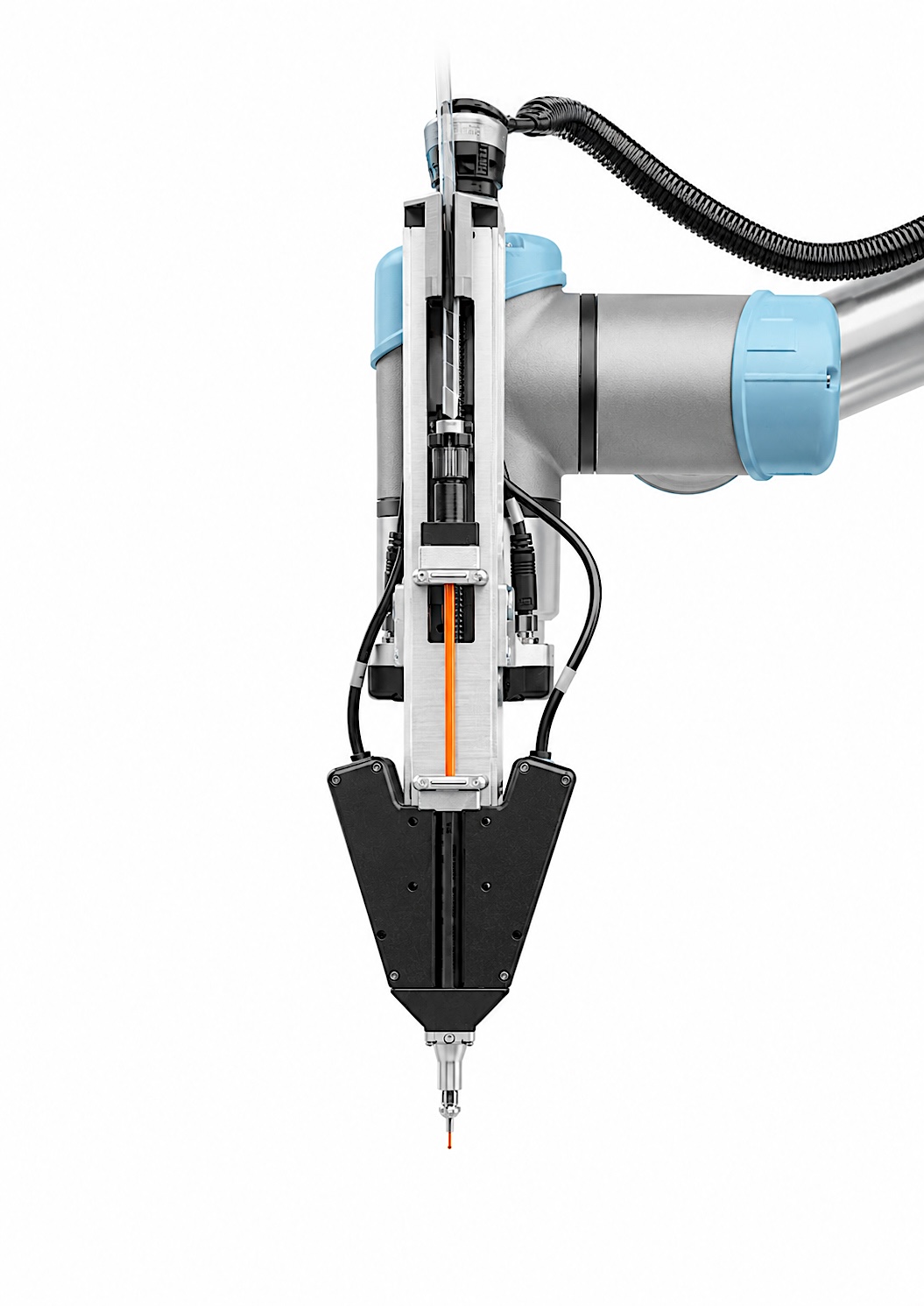
HR-DXA dispenser
Closed-loop position controlled dispenser with force measurement for precise fluid dispensing, equipped with a tendon-driven robotic system for needle flexion along one degree of freedom.
vision system
Board detection
The vision system detects board position within the cell, identifying features such as fiducials, so every board is bonded on its own reference frame.
explore the process
Sequence of operations
Step through the complete adhesive-application cycle, from board loading to homing.
Board loading
User positioning of the electronic board into the designated carrier for bonding applications.
Board detection
The vision system detects board position within the cell, identifying features such as fiducials.
Dispenser calibration
Homing phase of the tendon-actuated system, ensuring proper positioning and force distribution.
Automatic syringe pickup
Automatic retrieval of the syringe from the dedicated rack that holds syringes and plungers.
Automatic adhesive filling
A pressurized valve injects single- or two-component adhesive into the syringe.
Automatic plunger pickup
Magnetic pickup of the plunger from the dedicated storage rack.
Needle purging & cleaning
Adhesive dispensing homes the motors and removes air from the syringe, followed by needle cleaning.
Needle laser calibration
Laser sensors detect the needle zero position, accounting for needle variability.
Automatic bonding
Automatic application of adhesive onto the board following the toolpaths generated by the CAM program.
Used needle cutting
The needle is cut to keep the tendon system clean during removal of used syringe and plunger.
Repositioning
Used syringe and plunger are repositioned in their dedicated rack, leaving the dispenser free.
Homing
Homing of the robot and of every motor in the cell, returning the whole system to its zero position.
Technical data
Specifications
Standard cell configuration. Full datasheet on request.
Award
Winner of a design award.
The HR-GLX01 cell was recognised for its industrial design and engineering.
Trusted by

herocam · our in-house path generation software
HeroCAM
for Bonding.
The CAM software that programs, simulates and controls adhesive dispensing on electronic boards, from the 3D model to the running robotic cell.
Different bonding applications
Program any bonding strategy.
Operators simulate different bonding strategies, identify the optimal dispensing point and verify collisions, with full control over the geometric parameters of each profile.

S-Bonding
Creates an "S-shaped" adhesive path from the upper part of the component down to its base.

Wall Bonding
Creates an adhesive wall of a user-defined number of layers, starting from the lower part of the component.

L-Bonding
Creates an "L-shaped" path, or multiple connected "L" paths, embracing the component shape corners.

Perimetral Contour
Creates continuous adhesive paths that surround one or more components, welding them together.
Compatible with all geometries and fully customizable
Each toolpath is fully customizable, segment splitting and merging, adhesive flow, feedrate and tool orientation, for full control over the dispensing operation and repeatable, defect-free joints.
System Network Overview
explore the submodules
HeroCAM orchestrates every module of the HR-GLX01 cell over standard industrial protocols.
How does HeroCAM work?
One environment, the full dispensing workflow.
From importing the PCB model to running the robotic cell;
programming, calibration, simulation and process management in a single software.
CAM Programming & Path Generation
The Dispensing Solution environment lets users import PCB 3D models, define dispensing locations and create or modify optimized toolpaths directly from the digital model, with automatic program generation for robotic-cell execution.
Automatic Calibration & Board Recognition
HeroCAM aligns the digital model with the real PCB using a vision system and feature-recognition technology, ensuring precise dispensing even when board positioning varies. Program ID management enables automatic recognition.
Toolpath Simulation & Collision Detection
Before production, dispensing paths can be simulated in a virtual environment to verify movements and identify potential collisions between the dispensing tool and the PCB, reducing time and minimizing errors.
Dispensing Process Management
Dedicated tools for dispenser settings and adhesive process management, including first-fill procedures for new mixing cartridges and dispensing-system setup, for stable adhesive flow throughout the cycle.
Operator Panel
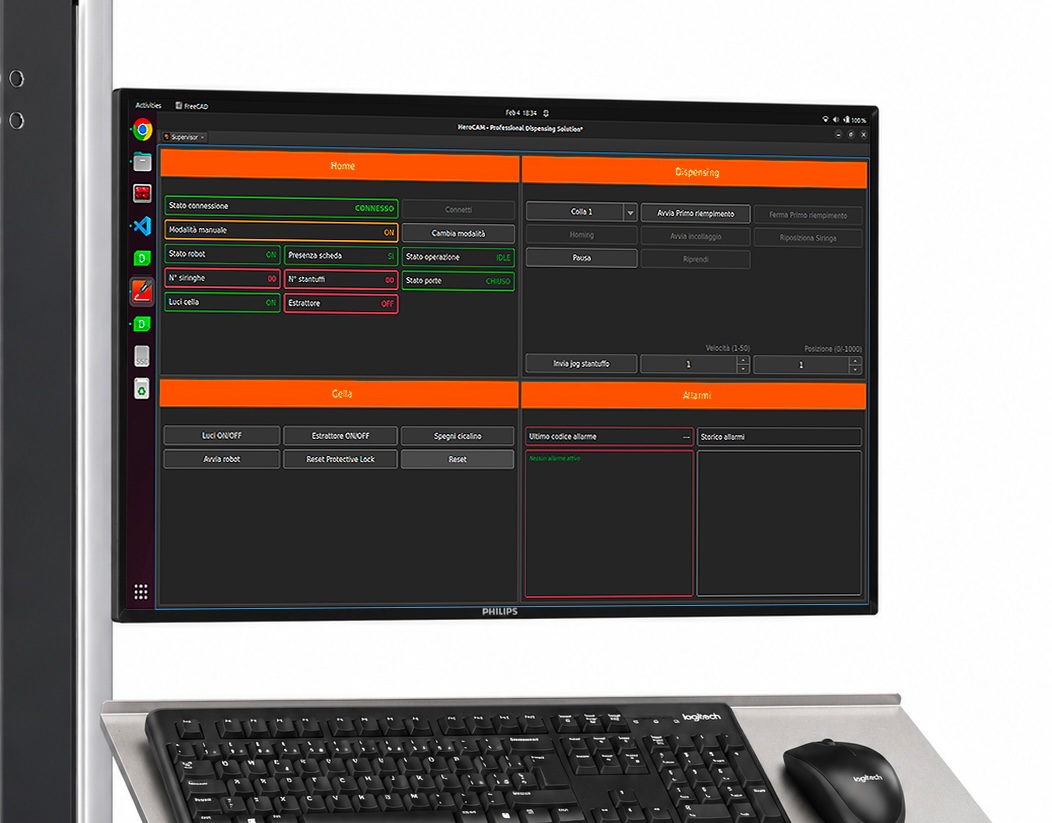
Run the cell from
a single screen.
A simple, intuitive interface for daily operation: monitor cell status in real time, manage auxiliary devices, execute manual procedures, start and stop cycles and access alarm information.
Integrations
customizable with every robot brand





